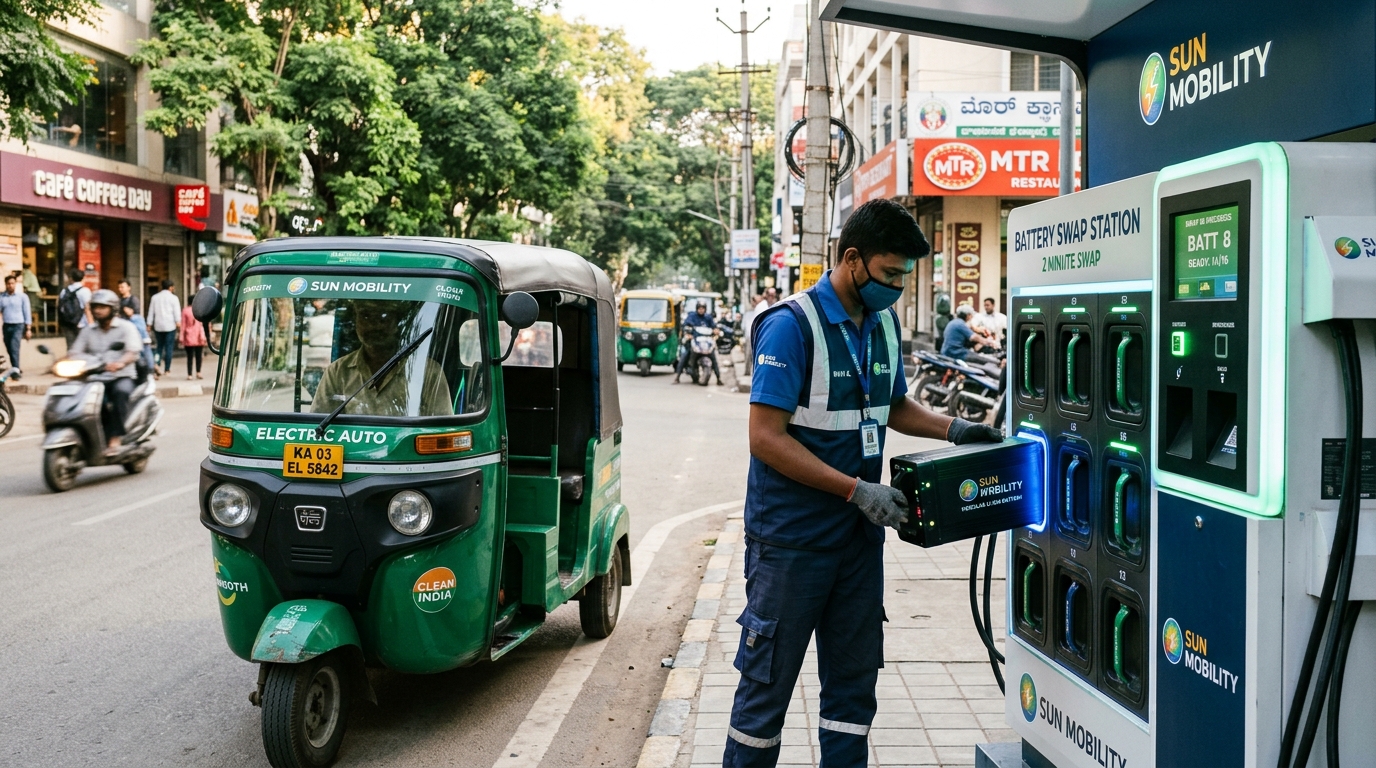
Under-Two-Minute Battery Exchange Mechanics
Three-wheeled auto-rickshaws provide crucial last-mile connectivity between metro stations and residential neighborhoods. However, lengthy four-hour plug-in charging historically caused drivers to lose valuable fare revenue.
Automated swap stations solve this bottleneck. Drivers pull into a compact kiosk, scan an RFID subscription token, deposit two depleted 48V lithium-ion battery modules, and receive fully charged, chilled replacement batteries in less than ninety seconds.
Because drivers lease the batteries as a service, the upfront purchase price of electric auto-rickshaws is reduced by 45%, making clean electric ownership far cheaper than traditional compressed natural gas (CNG) vehicles.
Smart Grid Integration and Off-Peak Battery Conditioning
The swapping stations are connected to municipal smart distribution transformers that condition and recharge hundreds of battery packs during nighttime off-peak grid hours.
Temperature-controlled charging compartments with automated aerosol fire suppression ensure safe, high-speed replenishment without straining the urban electrical grid.
Engineering Metrology, SCADA Telemetry and Field Calibration
Under operational protocols established across Karnataka civic agencies, real-time telemetry systems and industrial SCADA backbones ensure continuous data fidelity. Precision sensors calibrated to international metrological standards continuously transmit key physical parameters to central municipal monitoring suites.
Automated edge-computing nodes execute local anomaly detection routines, triggering immediate alerts when sensor readings deviate from baseline engineering parameters. This telemetry-first framework prevents cascade failures and optimizes preventive maintenance cycles across public utility corridors.
Statutory Regulatory Frameworks, Municipal Audits and Quality Compliance
Regulatory adherence is governed by strict state administrative codes and environmental quality standards. Independent third-party inspection agencies conduct mandatory quarterly audits to verify structural integrity, emissions compliance, and worker safety parameters.
All operational data logs are cryptographically stamped and archived on state government public dashboards, guaranteeing full transparency under the Karnataka Right to Information regulations and municipal oversight committee guidelines.
Urban Economics, Resource Efficiency and Sustainable Long-Term Horizons
From an urban economics perspective, sensorized infrastructure and formalized artisanal production networks generate significant efficiency dividends. Resource wastage is substantially reduced, lowering operational expenditures for civic bodies while creating skilled technical employment in municipal maintenance and data operations.
Regional planning authorities note that these modernized infrastructure deployments establish scalable blueprints for Tier-2 urban hubs across Karnataka, including Mysuru, Hubballi-Dharwad, and Mangaluru, reinforcing regional economic resilience and sustainable urban growth.