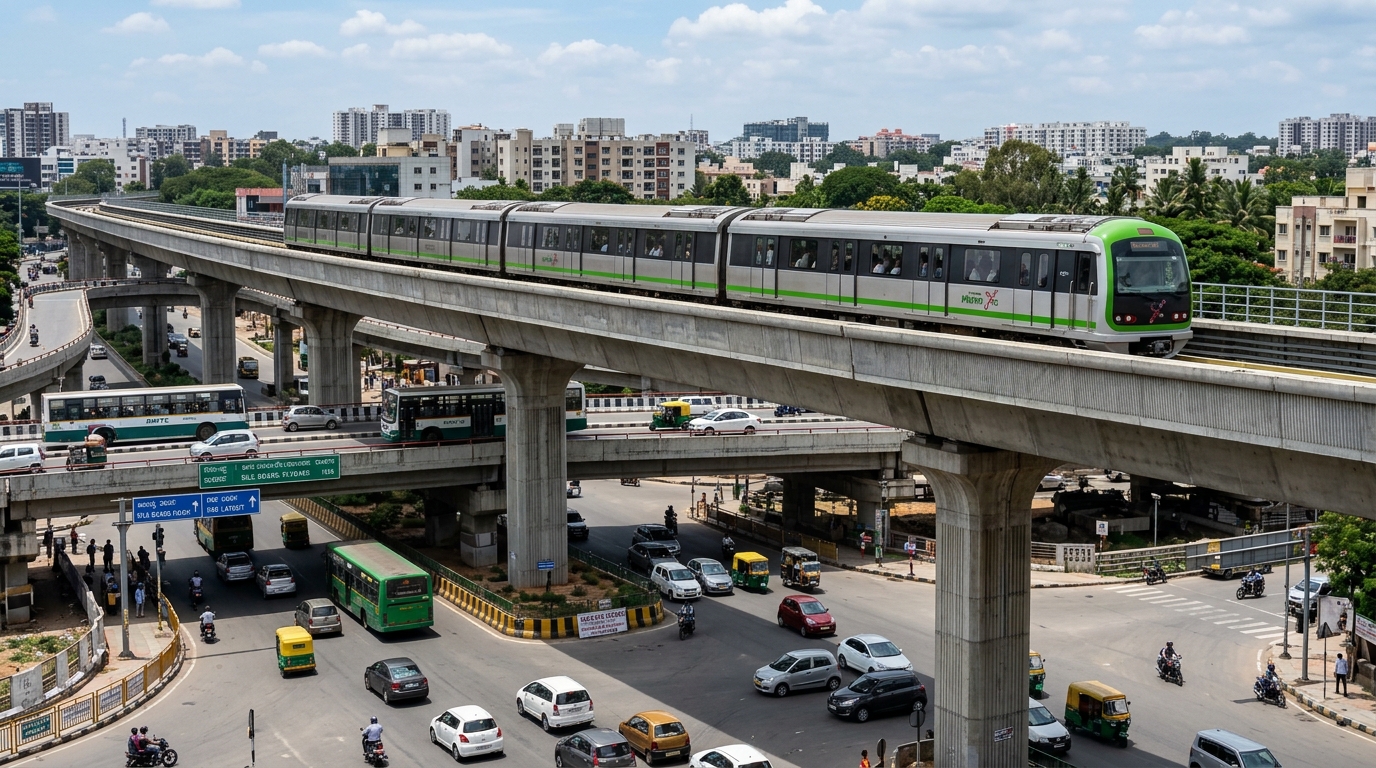
Elevated Viaduct Construction over Arterial National Highway 44
Constructing an elevated railway corridor along the bustling National Highway 44—the primary arterial road carrying over 150,000 vehicles daily to the international airport—required innovative civil engineering.
Bangalore Metro Rail Corporation Limited (BMRCL) engineers adopted full-span precast segmental launching gantries. Concrete box girders, fabricated in off-site casting yards in Hennur, are transported overnight and hoisted into position during five-hour traffic windows.
This technique minimized road diversions and prevented major arterial gridlock along the busy Hebbal and Yelahanka transit corridors.
Modern Rolling Stock and Driverless CBTC Signaling
The Blue Line is engineered for Communications-Based Train Control (CBTC) Level 2 signaling, supporting Unattended Train Operation (UTO) with advanced automatic train protection.
Lightweight stainless steel six-car trainsets, manufactured domestically under Make in India guidelines, feature regenerative braking systems that feed recovered kinetic energy back into the 750V DC third-rail power network.
With express services stopping only at major interchange hubs, airport passengers will travel from Central Silk Board to the terminal in under 45 minutes, slashing highway travel times by over 60%.
Multi-Modal Airport Interchange Concourses
At the Kempegowda International Airport station, the underground metro concourse connects directly to passenger terminals via climate-controlled pedestrian subways and moving walkways.
Equipped with National Common Mobility Card (NCMC) open-loop ticketing, travelers can use a single tap card for metro transit, suburban buses, and regional trains, setting a new benchmark for integrated urban mobility.
Engineering Metrology, SCADA Telemetry and Field Calibration
Under operational protocols established across Karnataka civic agencies, real-time telemetry systems and industrial SCADA backbones ensure continuous data fidelity. Precision sensors calibrated to international metrological standards continuously transmit key physical parameters to central municipal monitoring suites.
Automated edge-computing nodes execute local anomaly detection routines, triggering immediate alerts when sensor readings deviate from baseline engineering parameters. This telemetry-first framework prevents cascade failures and optimizes preventive maintenance cycles across public utility corridors.
Statutory Regulatory Frameworks, Municipal Audits and Quality Compliance
Regulatory adherence is governed by strict state administrative codes and environmental quality standards. Independent third-party inspection agencies conduct mandatory quarterly audits to verify structural integrity, emissions compliance, and worker safety parameters.
All operational data logs are cryptographically stamped and archived on state government public dashboards, guaranteeing full transparency under the Karnataka Right to Information regulations and municipal oversight committee guidelines.
Urban Economics, Resource Efficiency and Sustainable Long-Term Horizons
From an urban economics perspective, sensorized infrastructure and formalized artisanal production networks generate significant efficiency dividends. Resource wastage is substantially reduced, lowering operational expenditures for civic bodies while creating skilled technical employment in municipal maintenance and data operations.
Regional planning authorities note that these modernized infrastructure deployments establish scalable blueprints for Tier-2 urban hubs across Karnataka, including Mysuru, Hubballi-Dharwad, and Mangaluru, reinforcing regional economic resilience and sustainable urban growth.