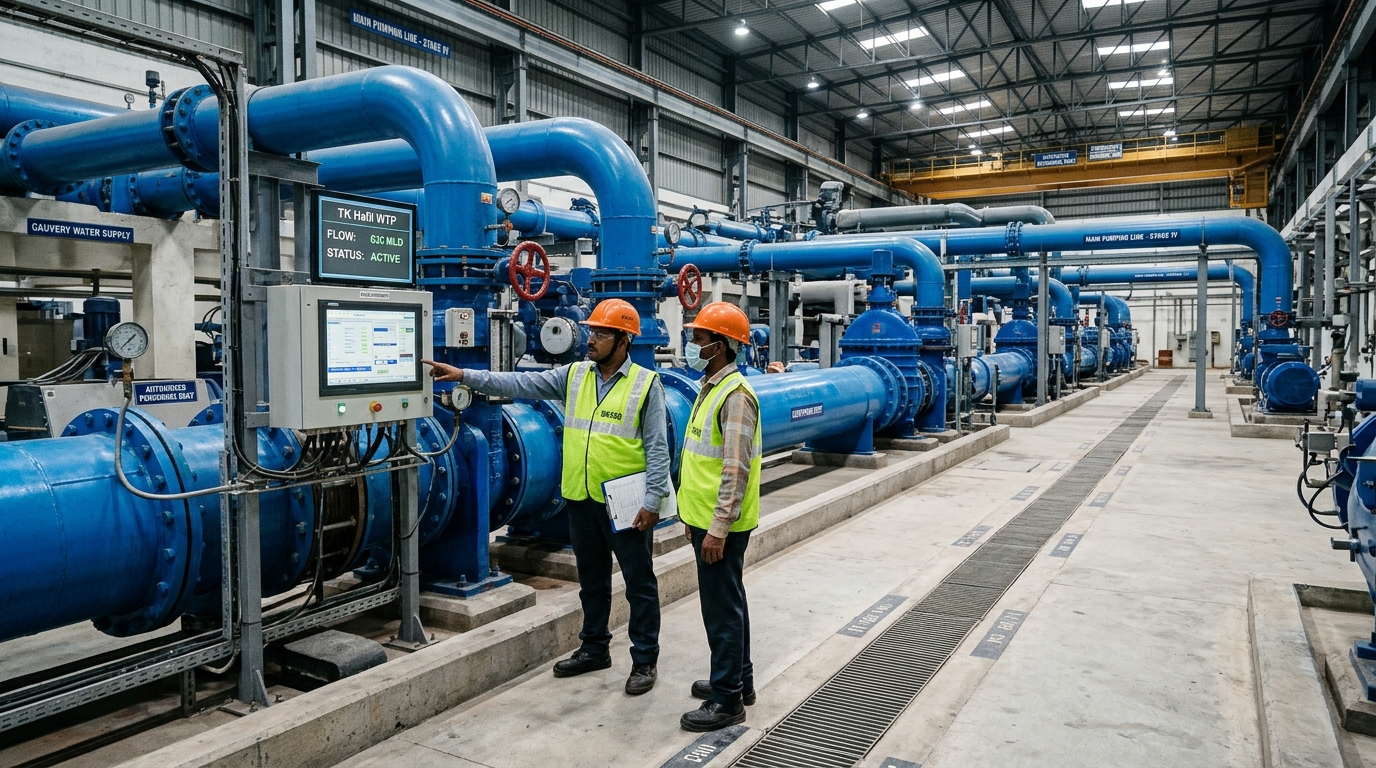
Centralized SCADA Telemetry and Pressure Management
The core municipal water distribution network spans over 10,000 kilometers of trunk and distribution pipelines across greater Bengaluru.
Under the new SCADA architecture, electromagnetic flow meters and automated pressure-reducing valves (PRVs) positioned at critical district metered areas (DMAs) transmit live telemetry every sixty seconds to the central control room in Cauvery Bhavan.
By dynamically regulating pipeline pressure during low-demand overnight hours, the automated system prevents high-pressure pipe bursts that historically caused major street flooding and water wastage.
Acoustic Correlators and Subterranean Micro-Vibration Detection
To detect hidden subterranean pipeline fractures before surface subsidence occurs, BWSSB engineers utilize magnetic acoustic correlator sensors clamped directly onto pipeline access valves.
The sensors listen to high-frequency acoustic hiss created by pressurized water escaping through hairline cracks. Sophisticated sound-wave velocity algorithms analyze time-delay differences between two sensor nodes, pinpointing the underground fracture location to within twenty centimeters.
This precision has slashed road excavation requirements by 80%, allowing rapid trenchless repairs and conserving over 85 million liters of treated water daily.
Ward-Level Transparency and Public Water Safety
In parallel with acoustic monitoring, optical sensors continuously measure residual chlorine levels and turbidity across 45 strategic distribution reservoirs.
Citizens can verify real-time water purity metrics for their local ward via the official mobile application, restoring public trust in municipal tap water safety across the technology capital.
Engineering Metrology, SCADA Telemetry and Field Calibration
Under operational protocols established across Karnataka civic agencies, real-time telemetry systems and industrial SCADA backbones ensure continuous data fidelity. Precision sensors calibrated to international metrological standards continuously transmit key physical parameters to central municipal monitoring suites.
Automated edge-computing nodes execute local anomaly detection routines, triggering immediate alerts when sensor readings deviate from baseline engineering parameters. This telemetry-first framework prevents cascade failures and optimizes preventive maintenance cycles across public utility corridors.
Statutory Regulatory Frameworks, Municipal Audits and Quality Compliance
Regulatory adherence is governed by strict state administrative codes and environmental quality standards. Independent third-party inspection agencies conduct mandatory quarterly audits to verify structural integrity, emissions compliance, and worker safety parameters.
All operational data logs are cryptographically stamped and archived on state government public dashboards, guaranteeing full transparency under the Karnataka Right to Information regulations and municipal oversight committee guidelines.
Urban Economics, Resource Efficiency and Sustainable Long-Term Horizons
From an urban economics perspective, sensorized infrastructure and formalized artisanal production networks generate significant efficiency dividends. Resource wastage is substantially reduced, lowering operational expenditures for civic bodies while creating skilled technical employment in municipal maintenance and data operations.
Regional planning authorities note that these modernized infrastructure deployments establish scalable blueprints for Tier-2 urban hubs across Karnataka, including Mysuru, Hubballi-Dharwad, and Mangaluru, reinforcing regional economic resilience and sustainable urban growth.